Dog's skin
One of the most common concerns for owners is a new lump that has appeared on or under their dog’s skin. As dogs get older, they can develop various bumps, lumps and skin changes. Some changes can grow quickly, while others appear over a longer period of time. A lump can be, for example, an abscess, a cyst or a tumour. Tumours can be benign or malignant. It is not possible to reliably assess what kind of change it is based on appearance alone. Various samples can be taken from the mass to guide the diagnosis and treatment plan.
Tumours that appear on the skin can be local, but they can also spread to internal organs. In this article we focus mainly on local changes on the skin.
In this article we go through the most common causes of lumps and the procedures that can be used to diagnose them.
In all tumour diseases, the prognosis is always better if the tumour is detected at an early stage. The risk of metastases and spread is then lower, and the tumour disease is easier to treat. For this reason, a new lump on your pet should always be shown to a veterinarian as soon as possible.
Symptoms
A lump in the skin does not necessarily cause the dog any symptoms. Sometimes, however, a lump can itch, ulcerate, become infected or interfere with the dog’s daily life and movement. If the dog has any general symptoms, such as a decline in general condition or changes in appetite, you should always see a veterinarian as soon as possible.
What could the lump be?
1. Benign tumours
Benign tumours do not usually spread metastases to other tissues. The most common types of benign tumour are lipomas and histiocytomas.
- Lipomas are benign fatty tumours. They are usually soft, slow-growing and generally harmless. Sometimes a lipoma can grow in an awkward place or cause the dog problems because of its size, in which case it can be removed surgically if necessary.
- Histiocytomas are usually small, red, raised masses that appear in younger dogs. They may disappear on their own without treatment, but sometimes they may need to be removed surgically or require treatment because of local skin inflammation or an awkward location.
2. Malignant tumours
- Malignant tumours can metastasise, i.e. spread to other tissues of the body. Malignant tumours include mast cell tumours, melanomas and soft tissue sarcomas.
- The appearance and rate of spread of mast cell tumours can vary greatly. Early diagnosis of a mast cell tumour is particularly important, because they can sometimes spread aggressively. If the tumour is detected early enough, the necessary further procedures can be carried out and the tumour removed surgically if needed. The spread of mast cell tumours must be carefully mapped, and in addition to surgery they may require chemotherapy or other treatments.
- Melanomas most often occur in the mouth or skin; a melanoma can be very aggressive and spread quickly.
- Soft tissue sarcomas are malignant tumours of the connective tissues; they usually grow slowly.
3. Mammary tumours
Mammary tumours are tumours that appear in the area of the teats and mammary glands. They can be benign or malignant. Surgical removal of mammary tumours is the recommended treatment. Before removal, staging and other basic examinations can be carried out. Mammary tumours most typically affect unspayed females, but in very rare cases they can also occur in spayed females and male dogs.
4. Cysts
A cyst is a hollow space within tissue that can be filled with fluid or other secretion. Most cysts are harmless, but sometimes they can become infected and require treatment or surgical removal.
5. Abscesses
An abscess can appear as a painful, acute swelling caused by infection. Abscesses usually appear as a result of a bite or a foreign body. Abscesses always require veterinary treatment.
6. Other
Only the most common findings are listed in this article; other diagnoses are also possible. Other skin changes can include, for example, papillomas and sebaceous gland adenomas. Papillomas are changes caused by a virus, usually appearing in young dogs, which do not necessarily require special treatment. Sebaceous gland adenomas are small, benign changes associated with the sebaceous glands.
Diagnosis
Whenever a new lump or mass-like change is found on a dog, it is advisable to show it to a veterinarian.
In a general examination, the size, shape, location and structure of the lump are assessed, along with whether there is inflammation in the area.
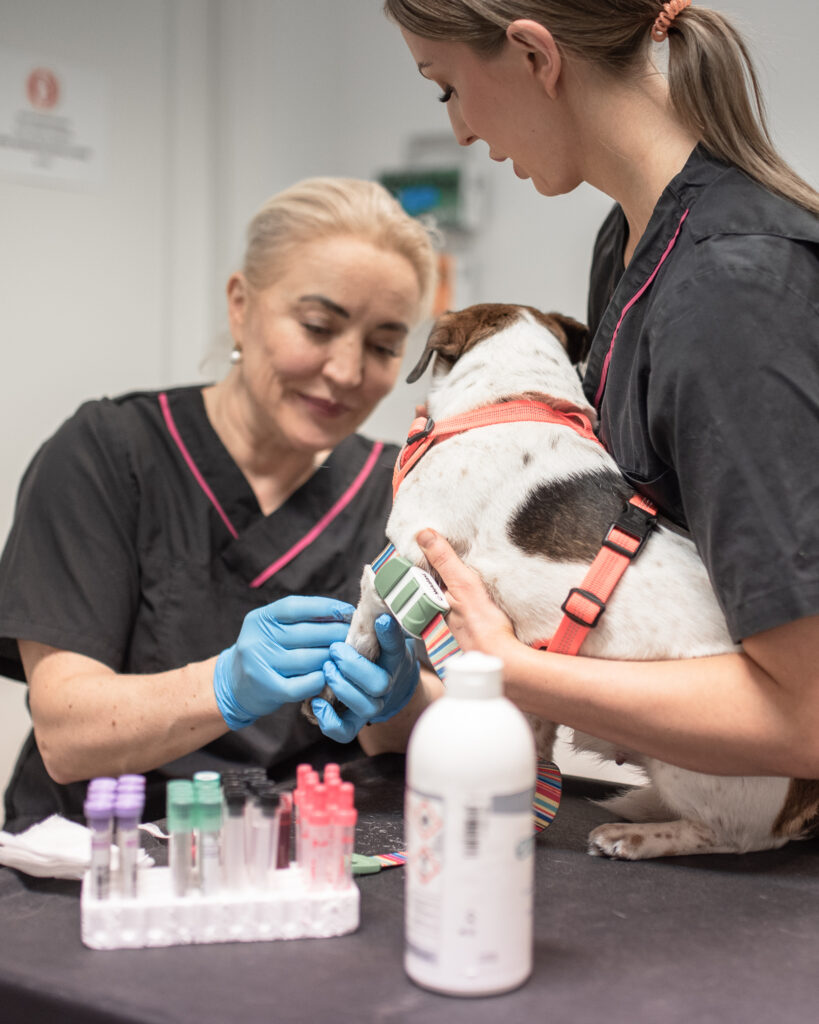
A fine-needle aspirate can be taken from the lump, in which cells are collected from the mass with a thin needle and spread onto a slide. The sample is usually assessed by a pathologist. The procedure is relatively easy and quick to carry out and often provides useful additional information about the mass. Based on the information from the sample, decisions can be made about the necessary further procedures. A biopsy can be taken from a mass where, for example, a fine-needle aspirate has not provided enough information, or which for some other reason requires this sampling method. The dog is sedated for the procedure, a biopsy is taken from the mass and the small remaining wound is closed with a stitch. The biopsy is sent to a pathologist for assessment.
Imaging, such as ultrasound, X-rays or CT scans, can be used to assess the mass or look for metastases elsewhere in the body.
The veterinarian always assesses the necessary procedures on a case-by-case basis.
Treatment options
Treatment always depends on the diagnosis of the lump. The treatment of a tumour disease depends on many different factors, such as the tumour type, location and growth rate. The tumour can be removed surgically, which is usually a curative treatment.
Certain types of tumour, such as mast cell tumours, may respond to medication that shrinks the tumour. More advanced treatments for malignant tumour diseases may include surgery, chemotherapy, electrochemotherapy or other treatments.
Benign tumours or cysts can also be monitored, or removed if they cause the dog problems, for example due to ulceration or an awkward location. Abscesses usually require lancing and antibiotic treatment.
When to contact a veterinarian?
Always contact a veterinarian if your pet
- has a new lump
- has a mass that grows quickly, changes shape, is painful, bleeds or has ulcerated
- has any general symptoms, such as weight loss, tiredness or reduced appetite
Various lumps in dogs are not uncommon, but they often worry owners. Although a lump may seem frightening at first, most changes can be treated at the veterinary clinic. Together we can consider the right measures to keep your furry friend healthy and happy.
If you are unsure about your dog’s lump, do not hesitate to book an appointment with us. If you have any questions or are not sure what kind of appointment to book, you can call us on 09 546 505 11 , we are happy to help!